I am a social psychologist who specialises in the study of crowd behaviour. I am interested in all situations when people come together in a crowd, either to protest, go to a sports match or festival, or if they get caught up in a mass emergency. I set this blog up to redress what I saw was a negative bias in the Press against crowds in general. Hope you like it!
Friday, 28 February 2014
Water cannon report update
Today (28/2/14) saw the final day of the public consultation process into the possible introduction of water cannon into British policing that was called by the Mayor of London's Police and Crime Committee (MOPAC). There have been interesting developments in this area since my previous blog entry that coincided with the release of my report, where I detailed my concerns about its possible ineffectiveness and the counter-productive effects that deployment and use of water cannon could have. Since my report went public, it has been widely disseminated via social media (despite no mainstream media interest as of yet) which has so far included over 100,000 tweets circulating the link to the report. There has also been a broader engagement in the general debate about water cannon. So thanks to all of you who showed an interest, and some of the highlights are detailed below.
Firstly, the public meeting to discuss the issue at the Greater London Assembly on 17/2/14 was well attended, and from watching the webcast, it seemed quite lively at times! (I was unable to attend as I had tickets to see Brighton play in the 4th round of the FA cup). One of the speakers from the floor cited an extract from my report about how the use of indiscriminate weapons such as water cannon could create a self-fulfilling prophesy of disorder (see p.10-11 of the published transcript), and Dietrich Wagner (the German pensioner who was blinded by water cannon in 2010) spoke movingly about his experiences and why he was opposed to its introduction. The police also showed their own CCTV footage of four different instances of serious disorder in London over the last 15 years, to provide examples of where they may have used water cannon had it been available, although the responses of the audience to each clip suggest that they were not convinced by these arguments.
There have also been interesting political developments in this matter. For instance, the London Assembly Police and Crime Committee issued a report arguing that the the Metropolitan police have not made a convincing case for the introduction of water cannon, and takes issue with how the consultation process has been conducted. Baroness Jenny Jones who is a Green member of the London Assembly has also been vocal in her opposition to water cannon, and sets out her case quite coherently in a seven page letter to the Mayor of London (Boris Johnson), sent on 24/2/14. In it, she takes issue with numerous specific points that she does not feel have been adequately addressed, and that the limited time-scale of the consultation process means that there may not be time to address them. She also very kindly cited my report;
"I have read the submission by Dr Chris Cocking...based on his research into crowd behaviour and public order policing. I feel his submission raises some very pertinent questions and concerns which have not been addressed by the Met[ropolitan Police] during this engagement and because of the brevity of the engagement they will not be addressed. I should like to see the Met responding to the concerns raised and explaining to the public how these concerns can be addressed before proceeding." p.5
The no to watercannon campaign group have also prepared a parliamentary briefing for circulation to MPs that details their opposition to the proposal to introduce water cannon, and highlight the concerns I raised about the risk of people developing hypothermia if they are soaked with water cannon and then confined in police 'kettles' for long periods of time in cold weather. Finally, there is a House Of Commons Early Day Motion (currently signed by 16 MPs) opposing the introduction of water cannon, with plans to raise questions with the Home Secretary about this matter on 10/3/14.
Conclusion:
It would be conceited of me to imply that my report on its own can influence decisions in this matter, and many other people have raised valid points in their opposition to water cannon far more eloquently than I could ever hope to do! However, I do feel proud to be at least a small part of a growing movement to raise concerns about the possible effects of the introduction and use of water cannon. Time will tell how effective these efforts have been, but I believe that a very clear and coherent case has been made arguing why such a blunt tool should not become part of British policing. Furthermore, if the decision is made to introduce water cannon, I would argue that this decision will have been made for short-term political reasons (rather than evidence-based reasons), and that such decisions are usually poorly made and deeply regrettable in the long term.
Monday, 17 February 2014
Water cannon report released today
There is currently an ongoing public consultation process called by the London Mayor’s Office for Policing And Crime (MOPAC) into the possible introduction of water cannon. A report I wrote in response to this consultation (to coincide with a public meeting called for 17/1/2014 at City Hall to discuss the issue) can be downloaded here, and a copy of the Press Release that was issued by my University is copied below. It will probably not come as a great surprise to regular readers of this blog that I am not in favour of the introduction of water cannon, as it is an indiscriminate public order tactic that will probably be ineffective and counter-productive in that it will be probably result in increased crowd conflict rather than less. I have also yet to see any consideration of the possible medical effects of spraying people with water cannon and then leaving them confined for long periods of time while soaked to the skin in possibly cold weather conditions (which seems a distinct possibility given the public order tactics commonly used in British policing). Therefore, I'm really worried that future protests in Britain could see multiple casualties from hypothermia if water cannon is used and then people are kettled afterwards.
For more information, see the No to water cannon campaign that has been set up against the proposals. Through crowd sourcing, they managed to raise over £1,000 so that a pensioner from Germany who was blinded by water cannon in 2010, can come and speak at this meeting about his own experiences at the public meeting on Feb 17th. If you read this before the public meeting (hosted by the Metropolitan Police Service and the Deputy Mayor at City Hall at 19:00 on 17 February 2014 in Room 5) please feel free to download and cite my report at it. If not, the public consultation is open until Feb 28th 2014, and you can send comments on the proposals to; watercannonengagement@mopac.london.gov.uk.
Press Release:
Dr Cocking said;
He also concluded;
The report will be available to download shortly via the following link;
For more details of his work on crowd behaviour also see Dr Cocking's blog;
For more information, see the No to water cannon campaign that has been set up against the proposals. Through crowd sourcing, they managed to raise over £1,000 so that a pensioner from Germany who was blinded by water cannon in 2010, can come and speak at this meeting about his own experiences at the public meeting on Feb 17th. If you read this before the public meeting (hosted by the Metropolitan Police Service and the Deputy Mayor at City Hall at 19:00 on 17 February 2014 in Room 5) please feel free to download and cite my report at it. If not, the public consultation is open until Feb 28th 2014, and you can send comments on the proposals to; watercannonengagement@mopac.london.gov.uk.
Press Release:
Water cannon: Dousing disorder or fatally fanning the
flames?
Dr Chris Cocking, a
Senior Lecturer at the University of Brighton today
released a report on the possible psychological and physical effects of the use
of water cannon. His report was done in response to a public consultation
process called by the Mayor of London’s Office on Policing and Crime (MOPAC)[1],
after plans were announced by the Metropolitan Police Service (MPS) to purchase
water cannon and hold them as a national asset that could be shared with other
police forces in the event of disorder in British cities similar to that seen
during the 2011 riots. This report has also been released to coincide with a special public meeting hosted
by the MPS and the Deputy Mayor at City Hall at 19:00 on 17 February 2014 to
discuss the issue.
In his report, Dr
Cocking argues that the introduction of water cannon into British policing
would be indiscriminate, disproportionate, and largely ineffective against many
of the behaviours seen during recent disorder (such as the widespread looting
in the 2011 riots). Furthermore, water cannon could even prove to be
counter-productive, as its appearance and/or use in potentially volatile
situations could increase the risk of disorder happening, or escalate it once
it begins. Finally, there could also be serious and possibly fatal medical
consequences (such as hypothermia) if protestors are soaked by water and then
contained behind police cordons for long periods of time in cold weather
conditions (as could happen if the ‘kettling’ tactic is used in conjunction
with water cannon).
Dr Cocking said;
‘This report is my attempt to illustrate my concerns about the possible
implementation and use of water cannon, and I also hope that it can be part of
an attempt to shift the argument back to a more evidence-based debate over the
effectiveness and/or appropriateness of the various tactics suggested to deal
with the recent urban disorder seen in Britain in recent years’
He also concluded;
‘The use of water in disorderly situations is best left to the emergency
service that has the most expertise and knowledge in this area (the Fire and
Rescue Services), and that water jets should be left to targeting fires, not
used to attack people in the misguided belief that it will help maintain ‘law
and order’.
The report will be available to download shortly via the following link;
For more details of his work on crowd behaviour also see Dr Cocking's blog;
Thursday, 9 January 2014
My thoughts on the Mark Duggan inquest verdict
Yesterday (8/1/14), the jury delivered their verdict at the end of the inquiry into the shooting of Mark Duggan by armed officers from the Metropolitan Police in August 2011. His death sparked a wave of riots across England, resulting in five further deaths, and hundreds of millions of pounds worth of damage. The jury decided by 8 to 2 that he had been 'lawfully killed', which prompted understandable anger from his family and supporters, who described the decision as perverse, given that the jury also agreed by an 8 to 2 margin that Mark was unarmed when he was shot. This anger was expressed by Carole Duggan (Mark's aunt) who started a chant of 'No Justice no Peace' outside the courts after the verdict, and the police statement that was read out afterwards was largely shouted down by angry protestors. I can sympathise with the family's anger and disappointment with this verdict, as it seems inexplicable how a jury can decide that someone was 'lawfully' killed despite also believing that he was not holding a firearm (and so posed no credible threat to the officers who shot him). However, I think it is also worth exploring how disorder can happen after such incidents, as I worry that fatalistic narratives can emerge arguing that riots inevitably follow, which need not necessarily be the case. So, I will explore the sequence of events leading up to the two major disturbances Tottenham has seen in the last 30 years, which were both sparked by fatalities at the hands of the police, and argue that such killings can certainly create incendiary situations which make disorder more likely, but that there are also often other specific factors that can lead to such riots happening.
Tottenham, August 2011:
The BBC provides a timeline of events after Mark Duggan's shooting, and what I think is significant is that he was killed early in the evening of Thursday 4th August, but the initial disorder in Tottenham didn't begin until late Saturday night on the 6th- which was over 48 hours later. In an interview with a friend of the Duggan family (Stafford Scott), he makes the point that if the police had behaved differently after the shooting, then the subsequent rioting may not have happened, and it seems that later events also sparked off the disorder in Tottenham which then spread nationally. Firstly, soon after the shooting, the Independent Police Complaints Commission (IPCC) briefed the Press that there had been an exchange of gunfire (when it was only the police who had actually fired any weapons), and this misleading information was not corrected until August 12th (after the riots had largely died down), meaning that the right wing Press (such as the Daily Telegraph and the Daily Mail) had already wrongly reported that Mark had fired at police first. The family had also received minimal information from the police in the immediate aftermath of Mark's death, and so called a protest march of around 300 people on the afternoon of Saturday 6th. They then waited over five hours outside Tottenham police station in an unsuccessful attempt to discuss the situation with a senior police officer. As the crowd became increasingly angry and more frustrated, a young female was apparently pushed to the ground by police reinforcements. This infuriated onlookers, and many concluded that it was this incident that triggered the initial riot in Tottenham, which then spread across London and various towns and cities in England over the next five days.
London riots August 2011
Broadwater farm riot, Tottenham- 6/10/1985:
The 1985 Broadwater Farm riot which saw some of the most serious rioting that has happened in mainland Britain in recent times, also has striking parallels with Mark Duggan's death. Over 600 Police were involved at its peak, and officers with plastic bullets were also deployed, (the first time this happened in mainland Britain) although they did not actually open fire. The riots happened after Cynthia Jarrett (a local Black woman) died of a heart attack during a bungled police raid on her house in the early evening of 5th Oct 1985, after her son had been arrested by the police. In this case, there was also a delay over 24 hours between Cynthia Jarret's death and the disturbances, and I would suggest that a chain of events developed after her death that led to the disorder. For instance, at 2pm the day after Cynthia died, an angry crowd gathered outside Tottenham police station, and began throwing stones, breaking a window. The local Police commander took a decision to not react and allow this expression of anger to happen, so the protest passed off peacefully after about 90 minutes. However, later on the same evening, an attempt by locals to leave the Broadwater Farm estate after a meeting and hold a similar protest had very different results. The local police had by now been reinforced by the Territorial Support Group (the specialist public order unit of the Metropolitan Police) and officers in full riot gear emerged and prevented the march from leaving the estate. This escalated into a full-scale riot in which 71 police officers were injured, and PC Keith Blakelock was killed (the first British police officer to die in a riot since 1833). The official inquiry by Lord Gifford (1986) concluded that the difference in policing at these two points in the day was a major factor in the specific timing of the riot, and describes the mood during the evening of 6th October;
'The youths leaving the estate were extremely angry. They not only knew that a Black woman had died in the course of a police raid; they were also sure that senior officers had not taken this death at all seriously. They were leaving the estate to demonstrate their feelings outside the base of local police power. They are confronted by 3 police vans with riot protection containing Police in riot gear. They express their anger by banging on the side of the lead van with their hands...the police response is massive. It takes the form of officers in riot gear coming out of their vans, stopping the youths from going further and pushing them back into the estate. For many of the youths this blocking of their free movement at such a time is intolerable. They react to it by using any means which are available. Yet in the same afternoon a different method of policing had been used. The same youths had stood and expressed their anger for 90 minutes in front of the police station. Here, the police had accepted that it was necessary to allow this to take place. We have no doubt that the youths were just as angry at this time as later on when they were leaving the estate. But in the afternoon there had been no disturbance' p 103-4 Gifford (1986)
The Broadwater Farm riot 6/10/1985
As I write this on the evening of Thursday 9th Jan, a vigil has been called by Mark's family outside Tottenham police station.at 2pm on Sat 11th Jan, to peacefully call for justice for Mark. The British media are already speculating whether there will be more disorder as there was after a similar protest in 2011, and I worry that this risks inflaming an already tense situation. For instance, the Times newspaper ran an alarmist story about riot squads being on standby in London after the verdict (and neglected to mention that the Metropolitan Police will probably have at least some specialist public order trained police on duty at all times, so they can be deployed at short notice if necessary). However, Stafford Scott pointed out on tonight's Channel 4 News that there have been many protests outside Tottenham police station against the disproportionate rates of deaths amongst members of the local Black community at the hands of the police that have not become riots. I remember going to one in 1999 after the death of Roger Sylvester, (who died in police custody after suffering a mental health crisis) and while it was angry and determined, it did not become a riot. I believe this was at least in part due to the fact that while there were police present at this protest, they stood back and did not interfere with the movement of the crowd up and down Tottenham High Road, leaving people to disperse in their own time.
I won't make any predictions as to whether or not there will be any disturbances in Tottenham this Saturday, as collective disorder involves a complex set of situations and social processes, that are also dependent upon how different groups interact with each other at specific points in time. It also concerns me that if we expect disorder at such events, we will not be surprised when it happens, and this will make it more difficult to properly explain them when they occur. Finally, it may also serve to obscure the apportioning of blame onto those whose actions may have been responsible for such disorder occurring. Both of the major disturbances in Tottenham in the last 30 years following fatalities that I have looked at can be explained at least in part to specific police actions after the fatal incident itself, and I worry that it is all to easy to overlook such actions if one assumes that disorder is inevitable after such incidents.
Postscript 12/1/14:
Further to my previous entry, the vigil for justice for Mark Duggan passed off peacefully, with no repeat of the disturbances of 2011 that spread across the country. Estimated numbers of those attending vary from 500 to 1000, and Mark's family and supporters released doves into the crowd. The police decided to close Tottenham police station for the afternoon, and their presence appeared relatively low-key with only Police Liaison Officers visibly present outside the police station as the rally began (see photo below), although there certainly would have been reinforcements in the vicinity and riot vans were spotted nearby. These tactical moves by the police may have been a factor in why the rally remained peaceful by removing possible sources of conflict between protestors and the police.
However, the peaceful nature of this rally was not helped by media speculation about whether or not there would be a riot (described as 'collective salivation' on Twitter), nor by the following extract from the statement put out by the Metropolitan Police Press Office, which seems to finish rather belligerently;
"Today is a busy day in the Capital and we have a policing operation in place across London. This includes having additional officers on standby that could respond to any incident that occurs. Part of this operation includes assessing all available information and intelligence, and we are aware of a limited amount of information that indicates a small number of people are expressing their desire to use this vigil as an opportunity. This information includes the intention of protest groups to attend and of people looking to provoke disorder. We will be ready to intervene immediately if required"

Crowd gathering outside Tottenham police station for vigil c. 14.00, 11/1/14
See my previous post for a Press release issued when I was at London Met University, just after the August 2011 riots had finished. In it I argued against simplistic and knee-jerk reactions to the disorder and also that debates about introducing more robust policing tactics (such as water cannon) were not only missing the point, but would also most likely be counter-productive.
Lord Gifford (1986) The Broadwater farm inquiry; available via; http://www.amazon.co.uk/THE-BROADWATER-FARM-INQUIRY-INDEPENDENT/dp/0951160400
Reicher, S. D. and Stott, C. J. (2011). Mad Mobs and Englishmen: Myths and Realities of the 2011 ‘riots’. London: Constable Robinson. available on Kindle via http://www.amazon.co.uk/Mobs-Englishmen-Myths-realities-riots-ebook/dp/B006654U9U (excellent detailed coverage of the August 2011 riots, that challenges many of the unsubstantiated myths that emerged in the media afterwards) .
Tuesday, 31 December 2013
2013 review of the year
Following my review of 2012, I thought I'd have another go for 2013 and also welcome new followers to my blog. I was initially inspired to write a blog following my experiences on holiday in Tunisia in Jan 2011 during the Jasmine revolution which was the first of many popular uprisings that became known as the Arab Spring, but it has since evolved into a general commentary of how I think crowds are often misrepresented in popular culture and discourse. 2013 has also been another busy year for me as I set about correcting what are often outdated myths about crowds that are rarely supported by detailed studies of their actual behaviour. My interests can broadly be described in the following three main areas which I will cover in turn in this review:
a) Exploring populist descriptions of crowd behaviour, questioning whether the terms used are useful in describing what people actually do, and considering the implications of such descriptions
b) How irrationalist views of crowds can affect the ways in which they are policed & how people involved in collective action protests can often experience positive and lasting psychological change
c) How those affected by mass emergencies can (and should) be used as a potential resource in their aftermath as people co-operate to support each other and rebuild their communities in times of adversity
A critique of 'panic' narratives
I began the year by looking at how a fatal fire in a Brazilian nightclub was reported, and I argued that using 'panic' to describe people's behaviour as they evacuated seemed to be not only inaccurate, but also risked diverting attention away from the possible negligence of the building's owners, as the wrong kind of pyrotechnics were used, and the club only had one working fire exit. I also looked at tragedies at two religious festivals in India this February and October, and argued that describing the crowds' actions as 'stampedes' could serve a similar purpose by blaming the 'crazed' behaviour of pilgrims rather than what looked like woeful crowd mismanagement on the part of the Indian authorities.
In May a paper I co-wrote with John Drury on the 1989 Hillsborough football disaster was published. In it, we explored how survivors of the disaster often used the term 'panic' to describe their experiences, despite clearly having good reason to reject the irrationalist implications that go along with such usage (the 2012 Hillsborough Independent Panel report concluded that fans were not responsible for the disaster, thus dispelling a controversial myth that had previously been propagated by some aspects of the media). We concluded that this was a good example of how people in such situations can be constrained by the language available to them, and that this was yet more evidence to show that the word 'panic' is inadequate to describe how people behave in such emergencies. Furthermore, use of this term in social discourse can encourage crowd management that views crowds from a public 'order' rather than public safety perspective, and the Hillsborough disaster is a tragic case of what can happen if crowd events are considered in this way.
In November, Typhoon Haiyan struck the Philippines, and the media were quick to talk about fears of the breakdown of law and order, freely using terms such as 'looting', although they presented little evidence to support this. I felt this was re-hashing clichéd narratives about how communities are supposed to descend into 'lawlessness' after natural disasters, and pointed out that there was similar reporting when Hurricane Katrina hit New Orleans in 2005, despite the fact that detailed investigations afterwards concluded that reports of such lawlessness were often vastly exaggerated, and crime rates tend to drop after such incidents.
Most recently, accounts from those who witnessed the recent collapse of the ceiling of Apollo Theatre in London's West End, showed quite well how people can co-operate in such situations, with existing social attachment bonds between family members and friends remaining. I also argued that people would also co-operate to help strangers in emergency evacuations, as a common identity often emerges in the face of a shared threat which encourages co-operation rather than selfish behaviour. This post was mentioned in an article in the Guardian, which massively increased hits on my blog, and quickly made it the most widely accessed post I have written so far.

The 1989 Hillsborough football disaster
Public order policing
In January, I had a paper published that looked at how the use of indiscriminate public order tactics (such as 'kettling' to contain crowds or charges to disperse them) could escalate rather than reduce crowd conflict because it psychologically united crowd members against a shared threat. Later in the year, there were marches in Brighton and London by the far-right English Defence League, and I looked at how such events can attract clashes in views of legitimacy which can result in actual physical clashes between opposing sides and/or the police. However, I also argued that the police's sometimes rather selective use of public order legislation (such as the 1986 Public Order Act) can exacerbate mutual distrust if there is a perception that opposing groups are being treated differently and make further conflict more likely. I also argued that the acquittals of two students charged with violent disorder after their involvement in the 2010 tuition fee protests, were good examples of how public order legislation is often underpinned by outdated irrationalist views of crowd behaviour.
The summer saw anti-fracking protests in Balcombe, West Sussex, and I looked at how those involved could develop a wider sense of collective identity that goes beyond the specific local issue they were protesting about, how there can be differing views of legitimacy between the protestors and the police, and how their measures of success could also go beyond the specific protest itself. Similar psychological processes also seemed apparent during student protests in England in March and December, and I argued that while the campaigns could be initially inspired by a specific issue, they could often grow into covering wider issues relating to Higher Education (and beyond), and even extend into a debate about the right to protest itself.

Police 'kettle' anti EDL protestors September 2013
First Responders
The final area I looked at was how those directly affected by mass emergencies are often best placed to respond in the immediate aftermath before outside help from first responders arrives. Therefore, they could serve as 'zero-responders', and this is a valuable potential resource that should not be overlooked in such situations. The attack on the Westgate shopping mall in Kenya this September showed how in this situation where first responders were delayed in reaching victims, uninjured bystanders helped others to escape, tend to the wounded, and in some cases, even lead security forces back into the Mall to locate other survivors.More recently, the Glasgow helicopter crash in November was a classic example of how people often rush into to emergency situations (instead of rushing away to reach safety) to help those in need, and the only people who seemed surprised about this were the journalists who had turned up to cover the story! Finally, when Lee Rigby's attackers were found guilty of his murder this December, I argued that this contradicted early psychological research that suggested bystanders were apathetic to others in need, and that in the right situations, people would intervene to help others.

Bystanders to Lee Rigby's murder intervene to confront the attackers before 1st responders arrive
References:
a) Exploring populist descriptions of crowd behaviour, questioning whether the terms used are useful in describing what people actually do, and considering the implications of such descriptions
b) How irrationalist views of crowds can affect the ways in which they are policed & how people involved in collective action protests can often experience positive and lasting psychological change
c) How those affected by mass emergencies can (and should) be used as a potential resource in their aftermath as people co-operate to support each other and rebuild their communities in times of adversity
A critique of 'panic' narratives
I began the year by looking at how a fatal fire in a Brazilian nightclub was reported, and I argued that using 'panic' to describe people's behaviour as they evacuated seemed to be not only inaccurate, but also risked diverting attention away from the possible negligence of the building's owners, as the wrong kind of pyrotechnics were used, and the club only had one working fire exit. I also looked at tragedies at two religious festivals in India this February and October, and argued that describing the crowds' actions as 'stampedes' could serve a similar purpose by blaming the 'crazed' behaviour of pilgrims rather than what looked like woeful crowd mismanagement on the part of the Indian authorities.
In May a paper I co-wrote with John Drury on the 1989 Hillsborough football disaster was published. In it, we explored how survivors of the disaster often used the term 'panic' to describe their experiences, despite clearly having good reason to reject the irrationalist implications that go along with such usage (the 2012 Hillsborough Independent Panel report concluded that fans were not responsible for the disaster, thus dispelling a controversial myth that had previously been propagated by some aspects of the media). We concluded that this was a good example of how people in such situations can be constrained by the language available to them, and that this was yet more evidence to show that the word 'panic' is inadequate to describe how people behave in such emergencies. Furthermore, use of this term in social discourse can encourage crowd management that views crowds from a public 'order' rather than public safety perspective, and the Hillsborough disaster is a tragic case of what can happen if crowd events are considered in this way.
In November, Typhoon Haiyan struck the Philippines, and the media were quick to talk about fears of the breakdown of law and order, freely using terms such as 'looting', although they presented little evidence to support this. I felt this was re-hashing clichéd narratives about how communities are supposed to descend into 'lawlessness' after natural disasters, and pointed out that there was similar reporting when Hurricane Katrina hit New Orleans in 2005, despite the fact that detailed investigations afterwards concluded that reports of such lawlessness were often vastly exaggerated, and crime rates tend to drop after such incidents.
Most recently, accounts from those who witnessed the recent collapse of the ceiling of Apollo Theatre in London's West End, showed quite well how people can co-operate in such situations, with existing social attachment bonds between family members and friends remaining. I also argued that people would also co-operate to help strangers in emergency evacuations, as a common identity often emerges in the face of a shared threat which encourages co-operation rather than selfish behaviour. This post was mentioned in an article in the Guardian, which massively increased hits on my blog, and quickly made it the most widely accessed post I have written so far.
The 1989 Hillsborough football disaster
Public order policing
In January, I had a paper published that looked at how the use of indiscriminate public order tactics (such as 'kettling' to contain crowds or charges to disperse them) could escalate rather than reduce crowd conflict because it psychologically united crowd members against a shared threat. Later in the year, there were marches in Brighton and London by the far-right English Defence League, and I looked at how such events can attract clashes in views of legitimacy which can result in actual physical clashes between opposing sides and/or the police. However, I also argued that the police's sometimes rather selective use of public order legislation (such as the 1986 Public Order Act) can exacerbate mutual distrust if there is a perception that opposing groups are being treated differently and make further conflict more likely. I also argued that the acquittals of two students charged with violent disorder after their involvement in the 2010 tuition fee protests, were good examples of how public order legislation is often underpinned by outdated irrationalist views of crowd behaviour.
The summer saw anti-fracking protests in Balcombe, West Sussex, and I looked at how those involved could develop a wider sense of collective identity that goes beyond the specific local issue they were protesting about, how there can be differing views of legitimacy between the protestors and the police, and how their measures of success could also go beyond the specific protest itself. Similar psychological processes also seemed apparent during student protests in England in March and December, and I argued that while the campaigns could be initially inspired by a specific issue, they could often grow into covering wider issues relating to Higher Education (and beyond), and even extend into a debate about the right to protest itself.

Police 'kettle' anti EDL protestors September 2013
First Responders
The final area I looked at was how those directly affected by mass emergencies are often best placed to respond in the immediate aftermath before outside help from first responders arrives. Therefore, they could serve as 'zero-responders', and this is a valuable potential resource that should not be overlooked in such situations. The attack on the Westgate shopping mall in Kenya this September showed how in this situation where first responders were delayed in reaching victims, uninjured bystanders helped others to escape, tend to the wounded, and in some cases, even lead security forces back into the Mall to locate other survivors.More recently, the Glasgow helicopter crash in November was a classic example of how people often rush into to emergency situations (instead of rushing away to reach safety) to help those in need, and the only people who seemed surprised about this were the journalists who had turned up to cover the story! Finally, when Lee Rigby's attackers were found guilty of his murder this December, I argued that this contradicted early psychological research that suggested bystanders were apathetic to others in need, and that in the right situations, people would intervene to help others.

Bystanders to Lee Rigby's murder intervene to confront the attackers before 1st responders arrive
References:
Cocking, C. (2013) Crowd resilience during the 7/7/2005 London Bombings: Implications for the Emergency Services. International Journal of the Emergency Services. 2 (2) 79-93.
Cocking C. (2013) Crowd flight during collective disorder- a momentary lapse of reason?Journal of Investigative Psychology & Offender Profiling. 10 (2) p.219-36. DOI: 10.1002/jip.1389
Cocking, C (2013) Collective resilience versus collective vulnerability after disasters- a Social Psychological perspective. In R. Arora (ed.) Disaster Management: A Medical Perspective.
Cocking, C. & Drury, J. (2013) Talking about Hillsborough: ‘Panic’ as discourse in survivors’ accounts of the 1989 football stadium disaster. Journal of Community and Applied Social Psychology. DOI: 10.1002/casp.2153.
Friday, 20 December 2013
Apollo theatre roof collapse
London's West End is reeling after the sudden collapse of the ceiling in the Apollo theatre during a performance of 'The Curious Incident Of The Dog In The Night-Time'. The performance was nearly full with around 720 people in the 775 capacity theatre, and 76 people were injured, with seven of them seriously. Mercifully though, no-one was killed, and the London Fire Brigade has stated that it was lucky more were not injured. The Guardian newspaper reports eye-witnesses hearing a bang and seeing a cloud of dust that some people initially thought was part of the performance.This quickly changed, as the seriousness of the situation became apparent, but the following quotes illustrate that people's behaviour remained orderly; "people realised it must be some sort of emergency and people started getting up... people didn't panic". The sudden and unexpected nature of this incident means that it was a potentially distressing experience for those affected, but people still remained calm; "people were scared, but they weren't screaming". I also saw a tweet from a colleague at my University who was in the theatre, and she acknowledges the distress, but refutes the idea of 'panic'.
"I tried to cover my daughter-in-law, who is pregnant, to protect her but some of the debris fell on her back".
These accounts are very much in line with the social attachment theory (Mawson, 2005; 2007), which argues that in emergencies people don't tend to 'panic', but seek out familiar attachment figures (e.g. friends or family), and tend to evacuate as groups. The idea that people will 'stampede' to save themselves is not supported by evidence. Work I have done with survivors of mass emergencies (Drury & Cocking, 2007; Drury et al. 2009) has supported social attachment theory. We also found that disasters can create a sense of shared identity, meaning that strangers can and do co-operate with each other in life-threatening situations. Finally, in a previous post I looked at coverage of a fire in a packed nightclub in Brazil, in January 2013, and argued that we should be careful not to rush to describe people's behaviour in such situations as 'panic', as it could deflect blame for possible negligence on the part of those responsible for the safe management of such events.
References:
Chertkoff, J.M. & Kushigian, R.H. (1999). Don’t panic: The psychology of emergency egress and ingress. Westport, CT: Praeger,
Drury, J. and Cocking, C. (2007). The mass psychology of disasters and emergency evacuations: A research report and implications for practice. http://www.sussex.ac.uk/affiliates/panic/Disasters%20and%20emergency%20evacuations%20(2007).pdf
Drury, J Cocking, C & Reicher, S (2009) Everyone for
themselves? A comparative study of crowd solidarity among emergency survivors. British
Journal of Social Psychology, 48, 487-506.
Mawson, A.R. (2005). Understanding mass panic and other collective
responses to threat and disaster. Psychiatry, 68, 95-113.
Mawson, A. (2007). Mass panic and social attachment: The
dynamics of human behavior. Aldershot, UK: Ashgate.
Thursday, 19 December 2013
Bystander intervention and the Woolwich barracks attack
Today (19/12/13), the jury reached a verdict in the Woolwich barracks attack of May 2013, and perhaps unsurprisingly both suspects were found guilty of the murder of Lee Rigby. The British media (such as this coverage by the BBC) is currently full of details of this shocking attack in broad daylight in a quiet area of suburban London. Therefore, I will limit this blog to focussing on the responses of the bystanders who witnessed it, as I think they yet again show the amazing resilience and courage that people can exhibit when exposed to such horrific situations. Furthermore, the notion that bystanders will always be apathetic to others in times of need (a concept known in Psychology as the bystander effect) is too simplistic and not always supported by evidence, especially during serious and/or life threatening emergencies.
In previous posts, I have looked at how survivors and bystanders intervened to help each other during the 7/7/2005 London bombings, and the Westgate shopping mall attack in Kenya this September, and this also seems to have happened immediately after the attack on Lee Rigby. Ingrid Loyau-Kennett, a cub scout leader from Cornwall (who is on the left in the image below) witnessed the attack, and become famous for her subsequent intervention. In interviews for the BBC, and the Daily Telegraph newspaper, she describes how she initially tried to help Lee Rigby, but then also engaged the perpetrators in conversation to try and prevent them from attacking others, and even asked one of them to hand over his weapon. The image also shows two other female bystanders talking to the other attacker.What I think is also significant, are the bizarre instances of near-normality in the period between the murder and the arrival of armed police on the scene. One of the attackers asked a bystander to film him while he made a speech seeking to justify his actions, and this became the infamous video clip that went around the world in the attack's aftermath. The footage shows the attacker speaking to the camera about the murder he has just committed, with his hands soaked in Lee Rigby's blood, as people walk past him, seemingly oblivious to what has just happened. I think both of these examples illustrate the almost complete lack of any 'panicked' behaviour in this situation, and also contradicts the idea that bystanders always ignore people in need (as the 'bystander effect' would predict).
Conclusion:
The murder of Lee Rigby was a truly shocking and horrific attack that risked dividing communities and briefly created a revival in the flagging fortunes of the Islamophobic English Defence League. However, a piece in The Guardian today argues it has instead had the opposite effect to that intended by the attackers (to start a 'holy war' between Muslims & non-Muslims) and united communities in their opposition to such attacks. I believe that the selfless and courageous acts by passers-by on the day were perhaps the first example of such opposition and show how people can unite and come together to support each other in times of adversity.
References:
Drury, J., Cocking, C., Reicher, S. (2009) The nature of collective ‘resilience’: Survivor reactions to the July 7th (2005) London bombings. International Journal of Mass Emergencies and Disasters 27 (1) 66-95.
In previous posts, I have looked at how survivors and bystanders intervened to help each other during the 7/7/2005 London bombings, and the Westgate shopping mall attack in Kenya this September, and this also seems to have happened immediately after the attack on Lee Rigby. Ingrid Loyau-Kennett, a cub scout leader from Cornwall (who is on the left in the image below) witnessed the attack, and become famous for her subsequent intervention. In interviews for the BBC, and the Daily Telegraph newspaper, she describes how she initially tried to help Lee Rigby, but then also engaged the perpetrators in conversation to try and prevent them from attacking others, and even asked one of them to hand over his weapon. The image also shows two other female bystanders talking to the other attacker.What I think is also significant, are the bizarre instances of near-normality in the period between the murder and the arrival of armed police on the scene. One of the attackers asked a bystander to film him while he made a speech seeking to justify his actions, and this became the infamous video clip that went around the world in the attack's aftermath. The footage shows the attacker speaking to the camera about the murder he has just committed, with his hands soaked in Lee Rigby's blood, as people walk past him, seemingly oblivious to what has just happened. I think both of these examples illustrate the almost complete lack of any 'panicked' behaviour in this situation, and also contradicts the idea that bystanders always ignore people in need (as the 'bystander effect' would predict).
Conclusion:
The murder of Lee Rigby was a truly shocking and horrific attack that risked dividing communities and briefly created a revival in the flagging fortunes of the Islamophobic English Defence League. However, a piece in The Guardian today argues it has instead had the opposite effect to that intended by the attackers (to start a 'holy war' between Muslims & non-Muslims) and united communities in their opposition to such attacks. I believe that the selfless and courageous acts by passers-by on the day were perhaps the first example of such opposition and show how people can unite and come together to support each other in times of adversity.
References:
Cocking, C. (2013) Crowd resilience during the 7/7/2005 London Bombings: Implications for the Emergency Services. International Journal of the Emergency Services. 2 (2) 79-93.
Cole, J., Walters, M. & Lynch, M (2011). Part of the solution, not the problem: the crowd's role in emergency response, Contemporary Social Science, 6 (3) 361-375.Drury, J., Cocking, C., Reicher, S. (2009) The nature of collective ‘resilience’: Survivor reactions to the July 7th (2005) London bombings. International Journal of Mass Emergencies and Disasters 27 (1) 66-95.
Friday, 6 December 2013
Student protests at Sussex and London Universities
Introduction:
Student protests are on the upsurge again, with a wave of actions across the country (including occupations at Warwick and Sheffield as I write this), but I shall focus on the Universities of Sussex and London, where there have been increasingly disproportionate responses to their respective campaigns. Many commentators have rightly highlighted the excessive and disproportionate response implemented by the respective university authorities and the police, and have also raised questions about the morality and legitimacy of such actions. However, I would argue that such responses may also be counter-productive to the aims of the authorities, in that they could escalate current discontent and broaden the protestors' determination and appeal to others, thus prolonging their duration.
University of Sussex:
Sussex University has suspended five of its students for allegedly leading an occupation of the Bramber House conference building in support of the recent strike by staff in HE on 3/12/13 (the last Sussex occupation is covered in my previous post), and these students are currently banned from coming on to campus for any reason (even to see their GP). These students face possible sanction and/or expulsion if found guilty of misconduct under the University's disciplinary procedures. Sussex's registrar, John Duffy claimed that recent protests had seen 'violence, intimidation or serious disruption', but the Sussex 5 reject such claims, and argue instead that this action, along with a previous injunction to prevent protests on campus after the last occupation is part of an attempt to stifle legitimate protest.
Since the suspensions happened, there have been daily protests on Sussex campus, which have attracted hundreds of students and staff. At today's rally (6th Dec), staff spoke out in favour of the suspended students, saying that they were being penalised not because they'd broken any rules, but to intimidate others from getting involved. More interestingly, a member of staff from the University and Colleges Union (UCU), reported that colleagues of his who had previously not been interested in the campaign against outsourcing of services at Sussex (and did not take part in the recent national strike action either), were so outraged by the suspensions that they had now become involved. This suggests that support is growing rather than diminishing, but also that the campaign is also concerned with wider issues are now, and as the protest moved off for its regular walk round Sussex campus, protestors were chanting "re-instate the Sussex 5, keep democracy alive". I also saw what is probably the best resignation letter I have ever read, from a porter at Sussex university who was not prepared to work at Sussex any more because of the current situation. He describes very eloquently how the Vice-Chancellor's actions had created a community at Sussex in opposition to the proposed outsourcing of services, and finishes by advising the VC to 'go and violate yourself brutally with a pineapple'!.
University of London:
The protests against the proposed closure of the University of London Union (ULU) have seen much more violent scenes, with police and private security forcibly removing protestors from Senate House on the evening of 5/12/13, and arresting up to 40 students in the process, with reports of injuries and photos posted on Twitter of students's blood on the pavement. ULU president Michael Chessum (who was recently arrested under the public Order Act for allegedly organising an 'illegal demonstration at ULU) said; "I saw a level of police violence and violence from university security staff that I have not seen for a very long time, if ever." Those arrested at the protests in London have also been given bail conditions by the police that include an order not to 'be in a group of 4 or more persons... in any public place', leading some to conclude that the police are attempting to ban protests.
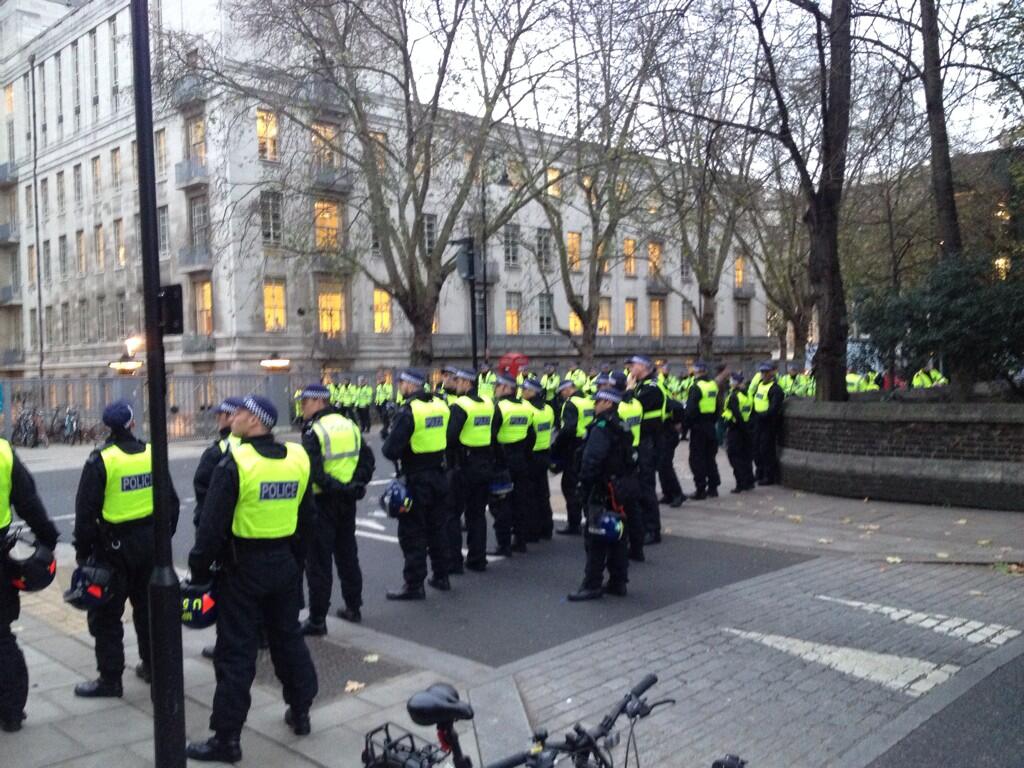
Coverage by the Guardian newspaper of the protests reported there was a strong police presence stationed around University of London from the outset, with a significant proportion being from the Territorial Support Group (TSG) that deal with public order protests- attracting criticisms from students of collusion between the police and the University of London management. The article continues by highlighting the contexts in which the protests are occurring, and how protestors are making connections with other causes beyond the immediate issues that they are protesting about . For instance, protestors can be heard chanting 'you killed Mark Duggan' at police (whose fatal shooting triggered the 2011 riots in England), showing a wider sense of identification beyond the immediate issue of the protests.

Territorial Support Group police deployed outside ULU 6/12/13
Conclusion:
It is clear to me that the way the campus protests are currently being dealt with at Sussex and London Universities illustrate the bureaucratic sanctions and also sheer physical brutality that student protestors can face. But I think these incidents can also unite protestors, widen their outlook (and consequent support), and make them more determined to continue with their campaigns. So, in these particular campaigns, what initially began as campaigns against outsourcing and/or closure of services, are now being openly discussed in terms of defending the right to protest. This is something that has been found in previous research (Cocking & Drury, 2004; Drury et al, 2003) into psychological change happening through involvement in collective action, and also in my exploration of the Balcombe fracking protests. On the day that the world is mourning the loss of Nelson Mandela, one of the world's most famous campaigners against injustice, I think it is appropriate that his name was invoked at today's rally at Sussex and a minute's silence called in his honour.

Dedicated to the memory of Nelson Mandela (1918-2013) and his struggle against apartheid
Drury, J., Reicher, S., & Stott, C. (2003). Transforming the boundaries of collective identity: From the "local" anti-road campaign to "global" resistance? Social Movement Studies, 2, 191-212.
Student protests are on the upsurge again, with a wave of actions across the country (including occupations at Warwick and Sheffield as I write this), but I shall focus on the Universities of Sussex and London, where there have been increasingly disproportionate responses to their respective campaigns. Many commentators have rightly highlighted the excessive and disproportionate response implemented by the respective university authorities and the police, and have also raised questions about the morality and legitimacy of such actions. However, I would argue that such responses may also be counter-productive to the aims of the authorities, in that they could escalate current discontent and broaden the protestors' determination and appeal to others, thus prolonging their duration.
University of Sussex:
Sussex University has suspended five of its students for allegedly leading an occupation of the Bramber House conference building in support of the recent strike by staff in HE on 3/12/13 (the last Sussex occupation is covered in my previous post), and these students are currently banned from coming on to campus for any reason (even to see their GP). These students face possible sanction and/or expulsion if found guilty of misconduct under the University's disciplinary procedures. Sussex's registrar, John Duffy claimed that recent protests had seen 'violence, intimidation or serious disruption', but the Sussex 5 reject such claims, and argue instead that this action, along with a previous injunction to prevent protests on campus after the last occupation is part of an attempt to stifle legitimate protest.
Since the suspensions happened, there have been daily protests on Sussex campus, which have attracted hundreds of students and staff. At today's rally (6th Dec), staff spoke out in favour of the suspended students, saying that they were being penalised not because they'd broken any rules, but to intimidate others from getting involved. More interestingly, a member of staff from the University and Colleges Union (UCU), reported that colleagues of his who had previously not been interested in the campaign against outsourcing of services at Sussex (and did not take part in the recent national strike action either), were so outraged by the suspensions that they had now become involved. This suggests that support is growing rather than diminishing, but also that the campaign is also concerned with wider issues are now, and as the protest moved off for its regular walk round Sussex campus, protestors were chanting "re-instate the Sussex 5, keep democracy alive". I also saw what is probably the best resignation letter I have ever read, from a porter at Sussex university who was not prepared to work at Sussex any more because of the current situation. He describes very eloquently how the Vice-Chancellor's actions had created a community at Sussex in opposition to the proposed outsourcing of services, and finishes by advising the VC to 'go and violate yourself brutally with a pineapple'!.
University of London:
The protests against the proposed closure of the University of London Union (ULU) have seen much more violent scenes, with police and private security forcibly removing protestors from Senate House on the evening of 5/12/13, and arresting up to 40 students in the process, with reports of injuries and photos posted on Twitter of students's blood on the pavement. ULU president Michael Chessum (who was recently arrested under the public Order Act for allegedly organising an 'illegal demonstration at ULU) said; "I saw a level of police violence and violence from university security staff that I have not seen for a very long time, if ever." Those arrested at the protests in London have also been given bail conditions by the police that include an order not to 'be in a group of 4 or more persons... in any public place', leading some to conclude that the police are attempting to ban protests.
Coverage by the Guardian newspaper of the protests reported there was a strong police presence stationed around University of London from the outset, with a significant proportion being from the Territorial Support Group (TSG) that deal with public order protests- attracting criticisms from students of collusion between the police and the University of London management. The article continues by highlighting the contexts in which the protests are occurring, and how protestors are making connections with other causes beyond the immediate issues that they are protesting about . For instance, protestors can be heard chanting 'you killed Mark Duggan' at police (whose fatal shooting triggered the 2011 riots in England), showing a wider sense of identification beyond the immediate issue of the protests.

Territorial Support Group police deployed outside ULU 6/12/13
Conclusion:
Dedicated to the memory of Nelson Mandela (1918-2013) and his struggle against apartheid
References:
Cocking, C. & Drury, J. (2004) Generalization of efficacy as a function of collective action and inter-group relations: Involvement in an anti-roads struggle. Journal of Applied Social Psychology 34 (2) 417-444
Drury, J., Reicher, S., & Stott, C. (2003). Transforming the boundaries of collective identity: From the "local" anti-road campaign to "global" resistance? Social Movement Studies, 2, 191-212.
Subscribe to:
Posts (Atom)